
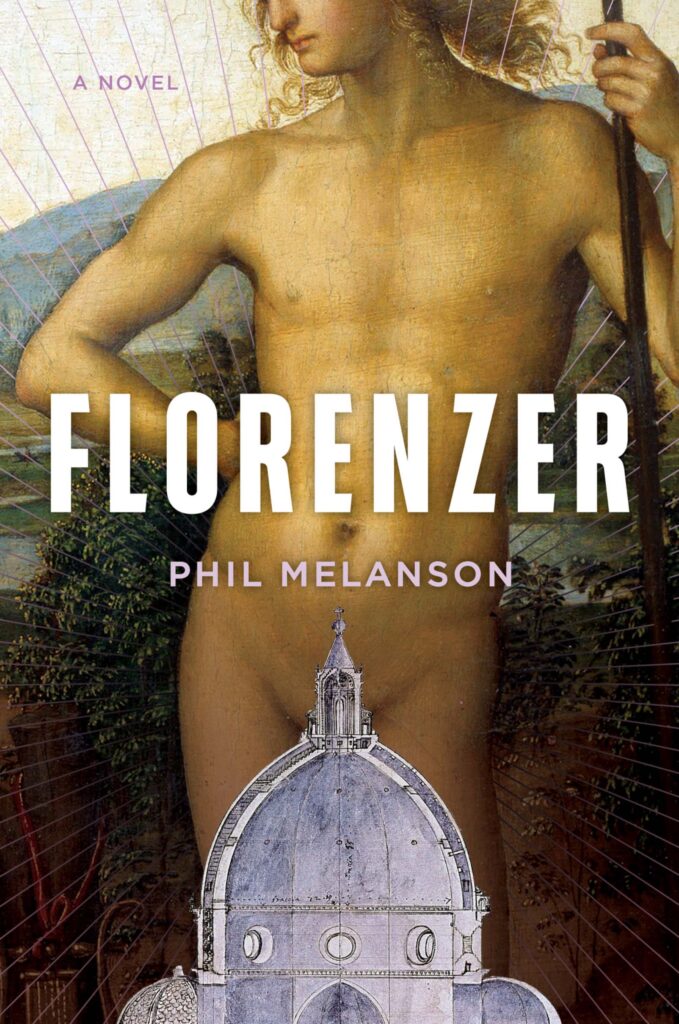
Florenzer by Phil Melanson (Liveright, 2025) is a historical novel about the youth of Leonardo da Vinci that explores his awakening to sexuality and his formative artistic years. It ends at the moment when Leonardo leaves Florence in 1482, leaving unfinished Adoration of the Magi, which had failed to please his patrons. The reader is left wanting more and eager to learn further.
The splendid biography dedicated to him by Charles Nicholl (Leonardo da Vinci: Flights of the Mind, Viking Penguin, 2004), which I suspect Phil Melanson may have drawn inspiration from, is the perfect complement.
Charles Nicholl skillfully combines analysis of the artworks with a biographical narrative, without overlooking the homosexual aspects of Leonardo’s life:
It is now widely accepted that Leonardo was homosexual. At least one of his early biographers, Giovanni Paolo Lomazzo, is explicit on the subject: in his Sogni e raggiona-menti of c. I564 he imagines the following dialogue between Leonardo and Phidias, the great sculptor of antiquity. Phidias asks Leonardo about one of his ‘favourite pupils’:
Phidias: Did you ever play with him that ‘backside game’ which Florentines love so much?
Leonardo: Many times. You should know that he was a very fair young man, especially around the age of fifteen.
P: And are you not ashamed to say so?
L: No! Why should I be ashamed? Among men of worth there is scarcely greater cause for pride.
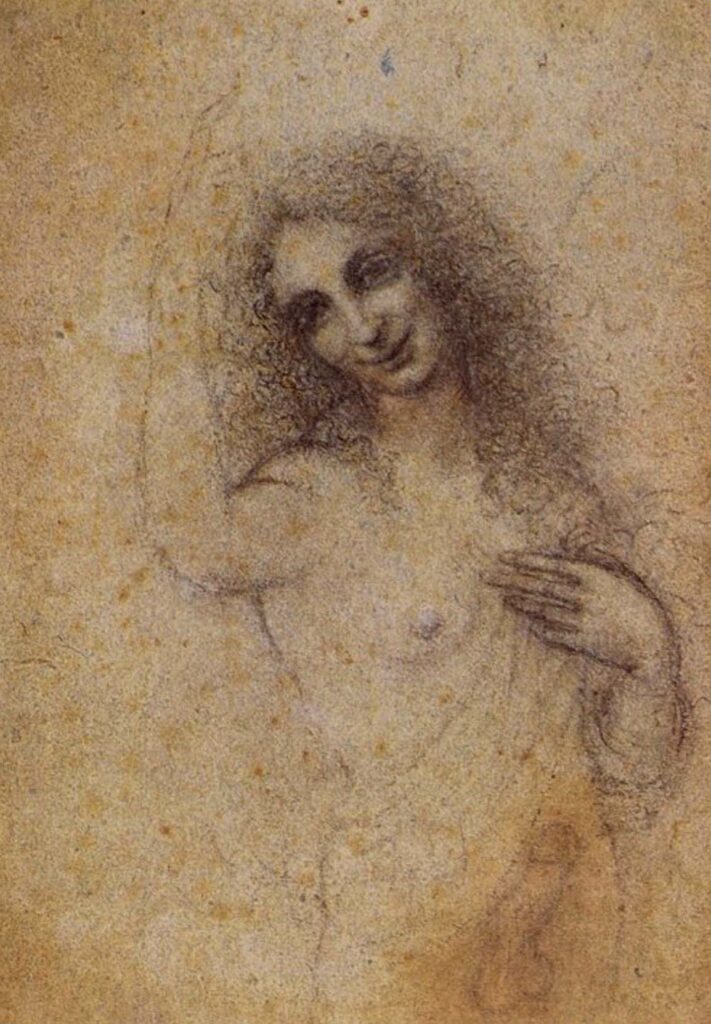
Lomazzo is particularly referring to Leonardo’s relationship with his Milanese pupil Giacomo Caprotti, known as ‘Salai’. Vasari is more discreet, but his description of Salai probably trails the same idea: ‘He was extraordinarily beautiful and comely, with lovely curling hair which Leonardo adored’. The adjective Vasari uses – vago: comely, pretty, charming – probably contains an overtone of effeminacy. Other young men flit into view in contexts suggestive of homosexuality – an apprentice called Paolo; a young man called Fioravanti: we shall meet these later. And while the preponderance of male nudes in Leonardo’s sketchbooks is conventional, some of his drawings are frankly homoerotic. The obvious instance is the so-called Angelo incarnato, with its full-frontal erection. This drawing is in turn related to the Louvre St John, probably his last painting: a meltingly poetic study of an androgynous-looking young man, with the cascading curls which he ‘adored’ in Salai, and which are a constant in his work from the first studio paintings of the early 1470s.
What did it mean to be gay in Quattrocento Florence? Predictably, the answer is complex and ambiguous. On the one hand, homosexuality was widespread, as is suggested by Lomazzo’s dialogue, where the ‘backside game of sodomy’ is particularly associated with Florence; the Germans went as far as to use the word Florenzer (Florentine) to mean a sodomite. In Medici circles, homosexuality was openly tolerated: the sculptor Donatello, the poet Poliziano, the banker Filippo Strozi were all known to be gay. Botticelli was reputed to be, and like Leonardo he was the subject of an anonymous denuncia; and among later gay artists there were Michelangelo and Benvenuto Cellini. The latter was apparently omnivorous: he recounts his heterosexual conquests with gusto in his autobiography, but it is a fact that in 1523 he was fined by the florentine magistrates for ‘obscene acts’ with one Giovanni Rigogli. Accused by the sculptor Bandinelli of being a ‘filthy sodomite’, Cellini replied with a flourish, ‘I wish to God that I knew how to exercise such a noble art, for we read that Jupiter practised it with Ganymede in paradise, while here on earth it is practised by the greatest emperors and kings.’ This catches, if ironically, the same idea which Lomazzo gives to Leonardo in his dialogue: that homosexuality is a ‘cause for pride’ among ‘men of worth’.